
Nerding out to The Martian
They could have just asked a space lawyer!


I recently re-watched “The Martian” and remembered how much I enjoyed it when it was released just over 10 years ago. Andy Weir, on whose book it was based, is a very clever and engaging writer, and Ridley Scott is a kick-arse director, but it was the humour brought by Matt Damon shoulder-wiggling to disco music that got me.
And I remember saying at the time that it was a very good recruitment ad for NASA. The main character Mark Watney had to science his way out of every problem, and we were along for the ride every step of the way, from growing potatoes in his own poop, to gaffa tape being the omnipresent survival tool. The movie even ends with him teaching astronauts in training. Surely a whole new generation of undergraduates would be inspired towards STEM degrees just based on this movie! (No doubt “Project Hail Mary” will have a similar effect, also based on an Andy Weir book.)
“The Martian” won so many awards, and science commentators credit it with being one of the most scientifically accurate sci-fi movies. I’ve met the NASA guy who was their advisor, ensuring they got every small detail right. What the script writers/directors/Andy Weir could have done, though, was just check with a space lawyer. Any of us. It would have been easy, and we would gladly have helped get those bits right too!
Space pirate!!
To be fair, international space law gets an explicit nod in this movie, which is already a huge win in my eyes! The most obvious were the references made by Watney himself. As he prepares to leave the US NASA-owned “Hab”, or the habitation pod, and cover a large distance in search of another US-owned rocket that’s been pre-placed for a future mission, he tells us in a video log that “there is a treaty that says no country can lay claim to anything that’s not on Earth.” (Listening, Moon racers??)
This is of course the 1967 Outer Space Treaty, Article II of which says that outer space, including any celestial body (all planets, moons and asteroids) is
“not subject to national appropriation, by means of claims of sovereignty or by any other means.”
He then tells us there is another treaty which says if you’re not in any country’s territory, maritime law applies. And that therefore Mars is international waters.
Wait, what? Why are you calling a dry desert-like planet “international waters”?? Also, why are you referencing a Law of the Sea treaty as if it applies to anything and everything that is not a country’s territory? There are other areas “beyond national jurisdiction”, like Antarctica, which is very much not “international waters”. Or like, you know, outer space.
Maritime law doesn’t apply. This thing called space law applies.
“International waters” is an important designation when it comes to rules of armed conflict, maritime trade routes, economic rights, fishing rights, deep sea bed resource exploitation. It has to do with the waters between sovereign territory here on Earth. It does not have anything to do with space.
But ok, let’s give some grace. It’s an easy way to translate in a few sentences during a building arc of tension in the movie, what it means that no State may claim sovereignty over any natural object in space. Many people have a basic understanding that international waters belong to no-one. Space belongs to no-one.
And then he tells us he’s a space pirate! Awesome, right?
Piracy is the oldest international crime, dating back centuries. These days it is defined in Art 101 of the UN Convention on the Law of the Sea as:
“any illegal acts of violence or detention, or any act of depredation, committed for private ends by the crew or the passengers of a private ship or a private aircraft and directed against…property in a place outside the jurisdiction of any State”.
Even if the Law of the Sea applied (which it clearly doesn’t), Watney is not using private ships, they are all US government property. Art 102 does go on to say that if a government crew mutinies and takes control of a government ship, then it can also be considered piracy, but only if one of those acts of violence, detention or depredation defined above take place.
If he were in fact commandeering a space vehicle without permission, we could maybe, maybe, maybe say he was mutineering. And given that he goes on to partially destroy the rocket when he finds it, he could, by some stretches of the imagination, be considered a space pirate.
But in fact he boards another US-owned rocket with the full consent and cooperation of NASA, and pulls bits off it at NASA’s own instruction, to try and make it lighter so it can escape Mars’ gravity and allow him to rendez-vous with his long lost crew. Thus, he moves from one space object which falls under US jurisdiction to another space object that falls under US jurisdiction, without breaching any international law. Sorry to burst your pirate bubble.
But then, you have been alone on a planet for 461 Martian days (“sol”, for the space nerds, adding up to over a year in Earth days). So we’ll let you be a space pirate.
Space criminals?
For space law nerds, Watney is correct that when he is in the NASA Hab, (and when he is in the rover, and also once he is inside the other US-owned object) he falls under US law. According to Article VIII of the 1967 Outer Space Treaty, the launching State maintains jurisdiction over a space object, and also over any personnel on board.
This jurisdictional point means that for anyone asking “what about crimes in space???” the simple answer is pretty boring. If a crime is committed on a spacecraft, the criminal laws of the State that retains jurisdiction over that spacecraft will apply. NASA rocket, US criminal laws.
On the International Space Station, it’s a bit like traversing borders between modules. If an astronaut commits a crime in the Russian module, Russian criminal law applies. If they move from the Russian module into the US module, they move jurisdictions.
It might get a bit complicated if they are in the US module, operating the Canadarm to enact a crime. Or if they are in the European Space Agency (ESA) module, which doesn’t fall under a single State’s jurisdiction. But we are basically in normal, every day criminal procedural law, so it’s not that special.
Many domestic criminal laws include jurisdiction over crimes committed by nationals of that country, even if the crime is committed outside that country (“active personality”).
Or against a national of that country, even if the crime is committed outside that country (“passive personality”).
Or if the effect of the crime is in the country - like drug trafficking, or cyber crimes (“territoriality principle”).
If there’s more than one jurisdiction that could apply, there are “conflict of laws” rules to determine which one applies, especially for transborder crimes.
Also, just to patch any gaps, there is a treaty called the International Governmental Agreement which governs the ISS. Under it, the individual European States that contribute to the ESA module retain jurisdiction over the astronauts of their nationality (active or passive personality would apply).
There has been one case of an astronaut being charged with what is essentially a cybercrime. In 2019, NASA astronaut Anne McClain was accused of identity theft while she was on the ISS. She used a NASA computer network to access her spouse’s bank account in the US, without permission. “The astronaut rejected the allegation, asserting that ‘she was merely doing what she had always done,’ with permission, ‘to make sure the family’s finances were in order.’ "
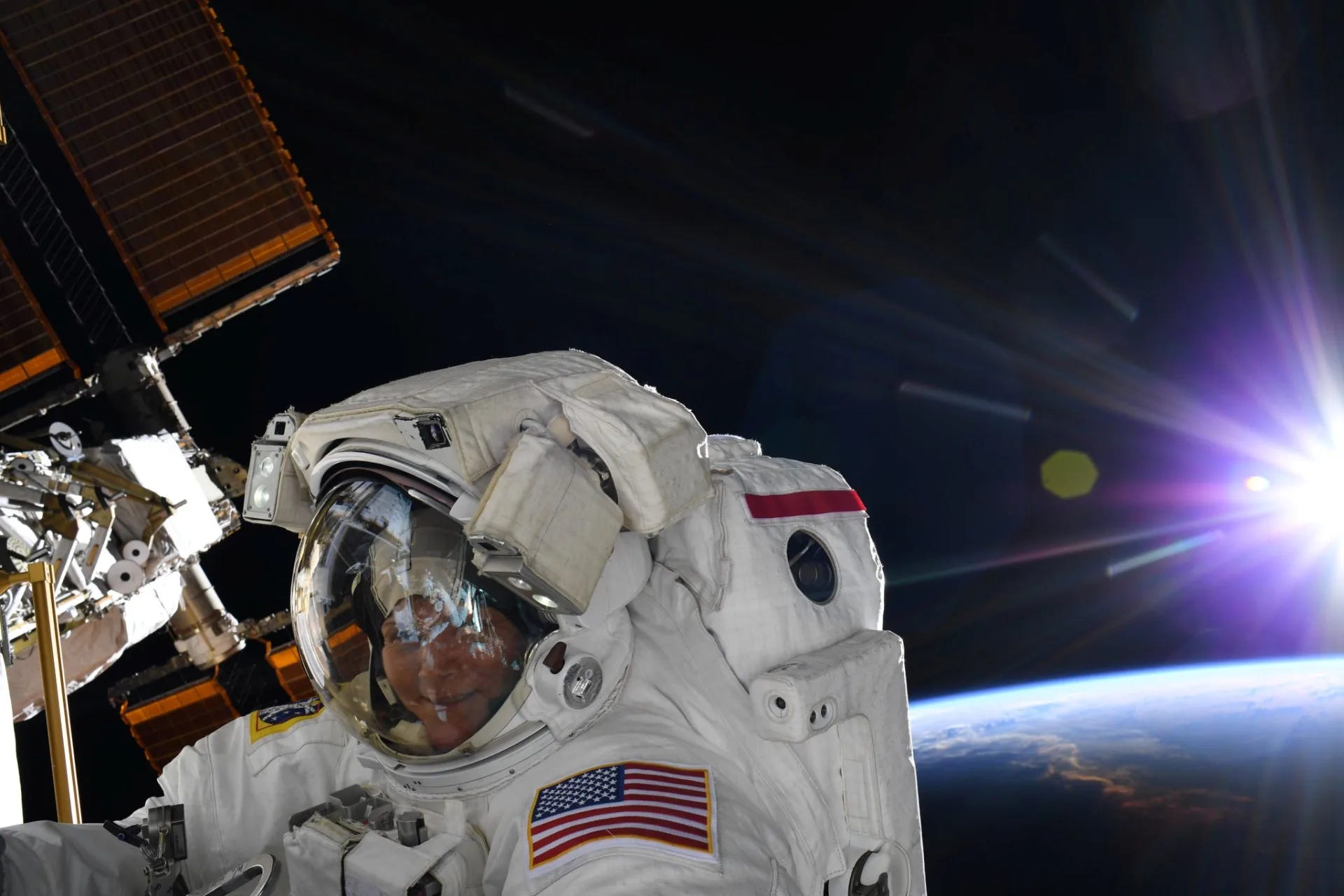
But again, this is just US law applied extra-territorially, as it normally would to a US citizen using government equipment outside US borders.
Space crimes, kinda boring for the time being. But space pirates? Let’s get back to Watney.
Space explorer?
Under Article I of the Outer Space Treaty, everyone has freedom of access to outer space and all areas of celestial bodies, without prejudice; thus Watney’s movement across the Martian terrain from the NASA Hab to the next is entirely permissible, as long as it is peaceful: Article IV of the Outer Space Treaty states that
“the Moon and other celestial bodies shall be used by all States Parties to the Treaty exclusively for peaceful purposes.”
So go in peace, space pirate. Just don’t do any marauding. Or damage the planet’s biosphere, which would be in breach of Article IX of the Outer Space Treaty, where it says that outer space activities must be conducted:
“so as to avoid their harmful contamination and also adverse changes in the environment of the Earth resulting from the introduction of extra-terrestrial matter”.
Also, there are (non-binding) planetary protection principles, so take care.
Astronaut in distress!
One important missing piece in the film is the international space law that obligates all States who are able to do so, to assist an astronaut in distress. Article V of the Outer Space Treaty denotes astronauts as “envoys of humankind”, and creates an obligation to assist the astronauts of any nationality which crash on one’s own territory or on the high seas. (Those international waters on Earth!) If a State has astronauts of its own in space who can help other astronauts, they must also do so.
We’ve already established Watney wasn’t on the high seas, and there are no other astronauts around, that’s the whole point. So maybe this doesn’t help him.
But the 1968 Astronaut Agreement took this a step further; Article 3 says if any personnel has “alighted” in any place beyond national jurisdiction:
“those Contracting Parties which are in a position to do so shall, if necessary, extend assistance in search and rescue operations for such personnel to assure their speedy rescue.”
The Astronaut Agreement almost didn’t come into being, since it includes clauses that obligate States not only to aid astronauts in distress, but also to return all space objects (think: space debris) that might land on one’s territory accidentally. Given the competition between the USSR and the US during the Cold War space race, space capabilities were kept highly secret. There was therefore some reluctance to agree to the obligation to hand over bits of an adversary’s technology which might otherwise be useful to study and gain intelligence.
However in 1968 in two separate incidents, both the US and the USSR suffered the loss of astronauts in tragic accidents. As a result, the political will shifted towards signing the Astronaut Agreement.
In the film, the Chinese Space Agency offers help to NASA of its own volition. It has a secret technology of which the US is unaware. It offers a small pod which can act as a rendez-vous with the larger space ship that is on course to Mars to rescue Watney, and in doing so gives away its secret technology. The decision to do so is a political one: the character Guo Ming, the head of the Chinese National Space Agency, says if the world were to come to know after the fact that China could have helped and did not, this would be disastrous.
It would have been nice to give a nod to that fact that China was in fact obligated to assist under Article 3 of the Astronaut Agreement, to which it is a party. But maybe the story is more emotionally compelling that it was a human and political decision rather than a legal one. I will be writing more about China in future posts, because I disagree strongly with the popular notion that China is the bogeyman or a rogue actor in space. In fact, sometimes even supposed adversaries will do the right thing.
Space diplomat
Indeed, this provides a prologue at the end of the film. A new cooperation is born between China and the US, shown between the space agencies and between the scientists, rather than between the heads of State.
This is in fact quite a likely depiction. During the Cold War, even as US presidents and USSR Chairmen changed, and policies on space changed too, still science diplomacy emerged on both sides, to share information for mutual benefit, and build trust. In 1975, the “most important handshake in space” took place during the Soyuz-Apollo mission, when a Soviet and an American spacecraft docked with each other, and US astronaut Thomas Stafford shook hands with Soviet cosmonaut Alexei Leonov.
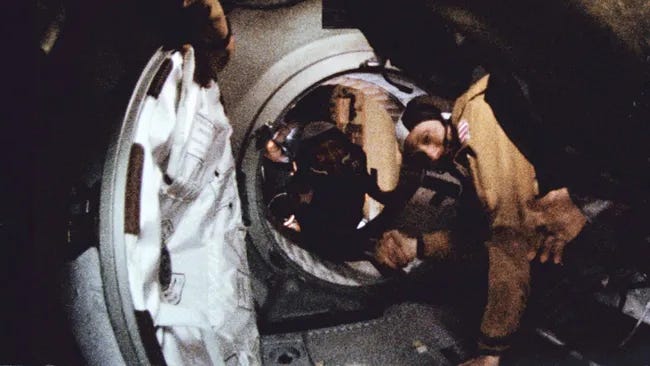
Certainly after the fall of the Berlin Wall, there were several decades of space cooperation between the two countries, not least with major funding for the International Space Station, together with the European Space Agency, Japan, and Canada. The ISS has often been hailed as the literal flagship for peaceful cooperation in space.
In this respect it was a shame that the scenario depicted in “The Martian” is an exclusively American NASA mission to Mars. Surely it has become clear that multinational projects are the most likely way forward for space activities, sharing the financial burdens and risks, but also benefiting in exactly the way the Outer Space Treaty intended. As Article I states:
“the exploration and use of outer space shall be carried out for the benefit of and in the interests all countries…”
But sadly, it’s not inaccurate to see a NASA-only mission depicted. As I’ve written before about the recent Artemis II mission, it was a great shame, though not at all unexpected, that the international narrative originally underpinning the entire mission was literally deleted from NASA webpages and communications. It was to be international, inclusive, even intersectional, and has instead become explicitly “America First” for “space superiority”.
A colleague and friend of mine, Dr Art Cotterell, wrote a a piece recently about Artemis and US leadership in space, which gained a lot of attention because it strikes a note: as the US acts in blatant and flagrant breach of international law in Venezuela and Iran, upends the global economy, threatens the sovereignty of Canada and Greenland, and fuels the flames in Gaza, do we really want it to be a leader in space? As Art says, “No superpower should be immune from scrutiny – on Earth or beyond.”
And as I’ve written elsewhere
Space is just another domain where geopolitics are playing out. Like the AI race or competition for oil, in space the US is seeking to remain the single dominant power and discovering that it no longer is. And it’s another domain where China is playing the long game, and where everyone else is thinking very carefully about how to build more sophisticated partnerships for a multipolar future.
-Cassandra Steer, “After Artemis II, the real lunar race is just getting started”, The Interpreter
That said, kudos to Andy Weir for depicting this Chinese-US cooperation in his book, and to Ridley Scott for highlighting it in the film. It is a story of collaboration and collective problem solving. In the final scenes, approximately a year after Watney has returned safely to Earth, the next Mars mission is being launched and it includes a Chinese astronaut. The Head of the Chinese National Space Agency and his advisor are in the room shaking hands with the NASA team.

“The Martian” topped the Chinese charts when it released in cinemas there in 2015, and one Chinese space official stated publicly that the film was an indication the US wants more cooperation in space. Regrettably, that turns out not to be true, but that statement itself is an indication that China is open to this (or was in 2015). It also shows the power of the arts as a messaging instrument, both to the public and to decision-makers.
The Martian is a wonderful story of optimism, scientific creativity, cooperation and collaboration. And for those of you taking notes: (mostly) in line with existing international space law.